The man who shocked the world, by Thomas Bass was really interesting.
In all fairness I like a lot of biographical non-fiction,
(If you ever get the chance, check out The Colony: The Harrowing True Story of the Exiles of Molokai by John Tayman, http://www.amazon.com/Colony-Harrowing-Story-Exiles-Molokai/dp/0743233018/ref=pd_bbs_1?ie=UTF8&s=books&qid=1238167682&sr=8-1). It's really interesting.
Anyway, I liked hearing about this guy's life. His most famous experiment about obedience is important as it is contraversial. People are much more likely to obey authority, even under relatively minor pressure, and this is something that disturbs most people.
More interesting to me though was his work on urban psychology and sociology. Such as his lost letter techniques, and how likely people are to help one another. I suspect that people may be even less helpful now-a-days, especially just passing by. Electronic devices and cell phones allow people to isolate themselves into there own enviroment, despite physically being in public areas.
The lost letter technique as a predictor of public opinion is also an interesting idea, but it is limited to polarizing issues that affect the population at large.
Overall, pretty cool book.
Friday, March 27, 2009

The Design of Future Things
This was a pretty good, book, I enjoyed it much more than his previous book, "The design of everyday things". It was a much more modern look at what could happen and how we will interact with it.
It seems that this book is predominately about automation, talking about how your house, your car, and seemingly everything will one day be automated, and it asks if this is a good thing. I wouldn't mind my car being able to act like a taxi, but I would also still like to be able to drive it myself. I wouldn't mind my house automating a few things, but trying to anticipate my every move, need, and whim, that's pretty complicated, not to mention creepy.
Visions of HAL, Shai'dan, and other science fiction digital villans warn of giving computers to much power, even at the end of his book, Norman gives a vision of talking machines, at which point you start questioning the author's sanity.
A few things I did like about the book were how much control could be given to the machines, such as in the "tight reigns, loose reigns" situations. I don't think I would mind have the equivalent of "electronic livestock", but trying to replace humans outright seems to be a bit troubling.
All Hail the Robot Overlords.
It seems that this book is predominately about automation, talking about how your house, your car, and seemingly everything will one day be automated, and it asks if this is a good thing. I wouldn't mind my car being able to act like a taxi, but I would also still like to be able to drive it myself. I wouldn't mind my house automating a few things, but trying to anticipate my every move, need, and whim, that's pretty complicated, not to mention creepy.
Visions of HAL, Shai'dan, and other science fiction digital villans warn of giving computers to much power, even at the end of his book, Norman gives a vision of talking machines, at which point you start questioning the author's sanity.
A few things I did like about the book were how much control could be given to the machines, such as in the "tight reigns, loose reigns" situations. I don't think I would mind have the equivalent of "electronic livestock", but trying to replace humans outright seems to be a bit troubling.
All Hail the Robot Overlords.
Tuesday, March 24, 2009
Navigating inside and outside of the box

Article Link: http://delivery.acm.org/10.1145/1360000/1357330/p1769-elmqvist.pdf?key1=1357330&key2=2033297321&coll=ACM&dl=ACM&CFID=28074669&CFTOKEN=14175303
Evaluating Motion Constraints for 3D Wayfinding in Immersive and Desktop Virtual Environments by Niklas Elmqvist (INRIA), M. Eduard Tudoreanu (University of Arkansas), and Philippas Tsigas (Chalmers Univ. of Tech.), did a study in which they tried using different camera systems for navigating a virtual world in both an immersive enviroment, and a desktop enviroment. They used a system called a CAVE, (Cave Automatic Virtual Enviroment) for the immersive enviroment, (a picture of a "cave" is above").
There are two main tasks in navigation, orientation and wayfinding. Orientation is finding out where you are, and wayfinding is figuring out how you are going to get to the next spot. People accomplish this task by building cognitive maps of an area, using spatial distances and landmarks.
What follows is three techniques to make a better cognitive map.
1. Global Coverage, the user should be exposed to all of the world they will be navigating in.
2. Continious Motion, the users can move smoothly from place to place, and don't have to
constantly reorient themselves.
3. Local Control: No matter how much you try to guide the user, you should ultimately let
them control there movement as they please.
User explored a variety of different areas, consisting of indoor and outdoor enviroments, as well as more abstract navigations (such as infoscapes).
They used three different methods for navigation, one was essentially like a tour guide, allowing users to change camera orientation. Another gave complete free reign to navigating through the enviroment. The other was kind of a hybrid between the others, the user was essentially on a leash that allowed them to wander around the area around the tour, but had to remain closeby.
At the beginning of the test the users traversed through the different enviroments. After they had accomplished this, they were given an overhead map and told to try and accurately place landmarks on an overhead map of the enviroment. In the final stage, the participants were to go back into the enviroment and to try and find objects within it.
As it turns out, while spring navigation seems to work the best for desktops, free motion worked the best for fully immersive enviroments. Guidance in CAVE's actually hurt performance.
I found this to be pretty interesting, that people are better off exploring in immersive enviroments than just being guided.
In the future they plan on studying people with long term experience with mental worlds who could form quite sophisticated mental maps of areas, such as video gamers who have played a particular game map a lot.
I thought that it was an interesting article. I myself have noticed in multiplayer computer games that some guidance through a new map is extremely helpful to being effective in the game. I would like to see further work on how training could happen using a virtual medium to provide a mental map for real world areas.
Tuesday, February 24, 2009
Zoetrope: Interacting with the Ephermal Web
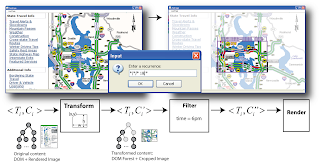
Eytan Adar, James Fogarty, and Daniel S. Weld of University of Washington, and Mira Dontcheva from Adobe Systems have created a "tool for interacting with the extended history of the World Wide Web". Based on the frequent changes that are made to the web, and the fact that we can frequently access only the most recent version, the point of Zoetrope is to allow easy access to the pasts of webpages through the manipulation of content streams. Content streams are made of tuples of times and content. It does this by having a crawler go through the webpages, and log it and any changes its made at, along with time stamps. Lenses can be placed on webpages, which allow previous versions to be explored.
Zoetrope has a zoomable canvas, through which the user can view past versions as well.
Below is a screenshot of Zoetrope in action.
The lenses can be used to have filters
The one above is a temporal lens, which allows a user to easily go through past versions of the page, focused on this area. This one is specifically for viewing traffic patterns. Various types of temporal lenses include: Visual Lenses, Structural Lenses, Textual Lenses. The visual lenses are like a cropping transform. Structural Lenses find all DOM inside the selection. Textual Lenses can track either exactly or approximately the same text, and tracks it's position on the page. The paper uses the example of tracking a sports teams ranking.
Filters can be applied to lenses. The filters can be done based on time, keywords, amounts, duplicate elimination, and combinations of filters, and trigger filters.
People would often want to combine various lenses, they can be bound together. All the sliders and other controls on the lenses are bound toghether as well.
Lenses can also be stacked, the paper sites the example of filtering for clear weather, and then introducing another time constraint of being between 6-7pm daily.
Despite all this data collection, one of the most important part has yet to be discussed, and that is the visualization side of Zoetrope. The simplest of these visualization methods is the timeline, which displays images data on a time axis. A similar manifestation would be the movie, which is a cycling of images, transitioning smoothly between them, similarly to a slideshow. Other types including clustering data onto tables, and time series, which allows for analysis of numeric data, like prices of books, or people at an event.
One of the nice benefits of Zoetrope is that much of the data can be exported to a google spreadsheet for further analysis.
It's a pretty interesting tool, and the team is looking forward in different expansions it could do to increase performance, as well as lower storage costs.
It looks pretty cool to me,
The full paper is at
http://srl.csdl.tamu.edu/courses/CHI2009/papers/uist08/UIST08_28_Adar.pdf
The full paper is at
http://srl.csdl.tamu.edu/courses/CHI2009/papers/uist08/UIST08_28_Adar.pdf
Thursday, February 19, 2009
Ups and Downs (Elevator or stairs?)
George, Drew, and I did our ethnography on the West Campus Garage, and how many people used the elevators or the stairs, and how. What we did is sat outside of the garage on the northeast side and watched the stairs and elevators, and recorded information about how many floors people went, how many floors they went, and what direction they were going.
As you can imagine, most people were going from or to the first floor. It was always interesting to see people who took the elevator for one floor, and laugh and consider myself morally superior though I have done that same thing countless times myself.
One interesting result is that most people are willing to walk a few stories, but once you get to three stories, there is a large spike. Apparently once it's three stories difference, it is now ok to use the elevators, with no loss in pride at the people watching you.
A few people noticed us observing them, and a few waved, which I though was fun.
Anyway, we observed them at three different times, with the most going on during the noon session. During that time we had some difficulty keeping up with everyone but we managed to. I missed the first time because I was somewhat ill at the the time, so I can't speak about that one. For the evening one though the atmosphere was much more relaxed, and thoughts turned more to elevator pranks in the interludes between data recordings.
Overall, I would have like to record for longer periods of time, from all the sides of the buildings, and recording more information, like major and class year. Much of the data we were able to obtain is unsuprising, but someone has to collect the data and analyze it so we can say we've "looked into the matter", or we have "top men" working on it, when we are asked by a jaded Dr. Henry Jones, who will promptly exit mumbling something about bureaucrats.
Anyway, movie references aside, it would have been interesting to interact with people in the elevators, even if it is socially awkward to strike up a conversation in a crowded place with no chance of physical escape, if only for a little bit. The study of human interactions on elevators is an interesting one, especially because the enviroment can rapidly change from one part to another. You can think of it like a long "cut" in a movie. We enter a magic box, what for the scene to change, and then walk out into the new one. Some of this could be alleviated by glass elevators, but we observed few people looking out the windows, most looking at the floor, the ceiling, the other walls, or the door.
Ah well, it was fun.
As you can imagine, most people were going from or to the first floor. It was always interesting to see people who took the elevator for one floor, and laugh and consider myself morally superior though I have done that same thing countless times myself.
One interesting result is that most people are willing to walk a few stories, but once you get to three stories, there is a large spike. Apparently once it's three stories difference, it is now ok to use the elevators, with no loss in pride at the people watching you.
A few people noticed us observing them, and a few waved, which I though was fun.
Anyway, we observed them at three different times, with the most going on during the noon session. During that time we had some difficulty keeping up with everyone but we managed to. I missed the first time because I was somewhat ill at the the time, so I can't speak about that one. For the evening one though the atmosphere was much more relaxed, and thoughts turned more to elevator pranks in the interludes between data recordings.
Overall, I would have like to record for longer periods of time, from all the sides of the buildings, and recording more information, like major and class year. Much of the data we were able to obtain is unsuprising, but someone has to collect the data and analyze it so we can say we've "looked into the matter", or we have "top men" working on it, when we are asked by a jaded Dr. Henry Jones, who will promptly exit mumbling something about bureaucrats.
Anyway, movie references aside, it would have been interesting to interact with people in the elevators, even if it is socially awkward to strike up a conversation in a crowded place with no chance of physical escape, if only for a little bit. The study of human interactions on elevators is an interesting one, especially because the enviroment can rapidly change from one part to another. You can think of it like a long "cut" in a movie. We enter a magic box, what for the scene to change, and then walk out into the new one. Some of this could be alleviated by glass elevators, but we observed few people looking out the windows, most looking at the floor, the ceiling, the other walls, or the door.
Ah well, it was fun.
Mole People
While reading the mole people, the strongest thought that came to mind is "I'm sure glad I'm not them". While the author seems to present these people as kind a kind of modern day, down-trodden hero, we are still able to get glances of just how bad it is there. Exposure, drug addiction, disease, bad food, and somehow we are supposed to believe they are living there own life of freedom? Many of these people could not exist if they were not adjacent to a large functional society. That's not to say this place doesn't have it's survivors, far from it, some of the people there have proven very adaptable and resourceful. And this is who the author focuses on, glancing over the ones who depend on others exclusively for there existence and happiness, those to high on drugs to care. Now people can change, it's part of life, and I hope they do, because people were not meant to live like this. But they do.
I wouldn't consider this so much an ethnography as just the author following a bunch of subjects around and then trying to turn it into a story about them. We receive a fairly limited amount of information about extensive external observations, most of it is people talking about themselves or others, hardly unbiased. Also the tone of the book is almost that of a camera that followed people around, with little to no emotional depth on the author's part. A critical part of human interaction is how the different parties feel. We are robbed of half of the interaction between the two. Did the author believe the person she's talking to? Did she feel there story believable?
Overall, the book was good to have read, though I doubt I will pick it up again. It gives a good perspective, if not necessarily what I think is the most accurate. The book left me with peculiar emotions about it, I am sorry that the conditions of the homeless, and I am glad some of them are making it, but I am frustrated by the people who are just letting themselves waste away. I don't look down on them, and they have my respect to them as another person, but nothing beyond that. It's good to have read, but I did not enjoy reading it, (part of that was I was sick, but only part).
I wouldn't consider this so much an ethnography as just the author following a bunch of subjects around and then trying to turn it into a story about them. We receive a fairly limited amount of information about extensive external observations, most of it is people talking about themselves or others, hardly unbiased. Also the tone of the book is almost that of a camera that followed people around, with little to no emotional depth on the author's part. A critical part of human interaction is how the different parties feel. We are robbed of half of the interaction between the two. Did the author believe the person she's talking to? Did she feel there story believable?
Overall, the book was good to have read, though I doubt I will pick it up again. It gives a good perspective, if not necessarily what I think is the most accurate. The book left me with peculiar emotions about it, I am sorry that the conditions of the homeless, and I am glad some of them are making it, but I am frustrated by the people who are just letting themselves waste away. I don't look down on them, and they have my respect to them as another person, but nothing beyond that. It's good to have read, but I did not enjoy reading it, (part of that was I was sick, but only part).
Thursday, February 5, 2009
The Media Equation
The media equation proved an interesting read. At the beginning I was somewhat apprehensive of the books approach and techniques, which were a little to much self-fulfilling prophecy for my taste. However, later in the book the authors confess that most of these predictions were discovered after the experiment. I feel that the formatting of the book might have read better that way. I understand the structure of making a point and then supporting it, but I believe it would have been better presented as a discovery mounted from evidence previously provided. Once I got past that though I did enjoy the material quite a bit, especially the portions about cuts and negativity. Typically, computers don't adopt a negative tone towards people, but you deal with "cuts" of a sort rather regularly. Transitioning screens to applications, pop-ups, and different facets of the same application. Part of the reason people hate pop-ups might be explained by the fact that they are an "unrelated" cut from what's going on (I'm talking about internet pop-up ads, no just a regular dialog box native to an application).
Screen size and focus are something interesting to me, specifically for the purposes of video games. The idea for me was large screen TV's, while great for presenting movies and the like, may take away from a video game. With the bigger screen we can only focus on a smaller part of the screen relative to smaller TV's. The problem that arises is that information is spread to far apart, relegated to peripheral vision. For example, in a First Person Shooter game, a big part of those games is being aware of your surroundings, and noticing any items of importance (allies, enemies, weapons), on the screen in front of you. I often find myself having to check various parts of the screen on a big TV, and often miss someone I could have easily seen on a smaller screen.
Of course, big isn't the only problem. Small screens may try and mash to much information together on a single screen, such that UI is polluted by so many extras that the actual gameplay is hamstrung as a result. This is more likely to happen in hand-held games, (my experience is from Civilization Revolutions for the Nintendo DS).
My specific interest in media is video games, so it was interesting to try and apply all of these various things into it, in a very interactive social media.
- Eric
Screen size and focus are something interesting to me, specifically for the purposes of video games. The idea for me was large screen TV's, while great for presenting movies and the like, may take away from a video game. With the bigger screen we can only focus on a smaller part of the screen relative to smaller TV's. The problem that arises is that information is spread to far apart, relegated to peripheral vision. For example, in a First Person Shooter game, a big part of those games is being aware of your surroundings, and noticing any items of importance (allies, enemies, weapons), on the screen in front of you. I often find myself having to check various parts of the screen on a big TV, and often miss someone I could have easily seen on a smaller screen.
Of course, big isn't the only problem. Small screens may try and mash to much information together on a single screen, such that UI is polluted by so many extras that the actual gameplay is hamstrung as a result. This is more likely to happen in hand-held games, (my experience is from Civilization Revolutions for the Nintendo DS).
My specific interest in media is video games, so it was interesting to try and apply all of these various things into it, in a very interactive social media.
- Eric
Subscribe to:
Posts (Atom)